Seems like just lately, people are finally getting worked up about the GM salmon I wrote about a couple years ago (yeah, that's a little disappointed smugness). Many people, who I don't think realize how many other GMO's they're eating on a regular basis have taken on the salmon battle. We often tend to think in concrete, one dimensional ways about our food, so it's easy to tell ourselves that we don't eat soy, or sugar beets, so we're not part of the GMO experiment. Sadly, as I've oft pointed out here, 70% of food in the grocery store contains genetically modified material. But it's much sexier to battle it out against a giant salmon than a cotton ball (also GM), so it's getting a bit of attention right now. I'd like to suggest however, that there is a far larger threat to our food system than that terrible fish, but it's probably the least exciting crop and feels the farthest from our plates, so may take some time (which we don't have) to get the attention it deserves.
Alfalfa. Unless you eat sprouts on sandwiches, chances are, you're thinking "I don't eat alfalfa, that's rabbit food." Well, unless you survive solely on a diet of organic vegetables grown in your own garden, you're bound to be part of the GM alfalfa experiment.
Alfalfa is that pretty blue flower you see in lush looking pastures about the same time that the pink clover is flowering. It's a legume, so fixes it's own nitrogen and is a particularly nutritious forage for cattle. It is a bit rich for sheep, but they love it and we recently incorporated it into our newest pasture. It doesn't make great hay because the leaves are smaller and tend to fall off by the time it goes through a rake, tedder and baler, but it makes beautiful silage and haylage and is a key component to the diet of dairy cattle. Alfalfa is extremely common across the country and (here is the important part) is a happy hunting ground for bees on the look out for pollen. The flowers are close together and easy to access and you might actually see honey labelled as 'alfalfa honey' from time to time. And when bees get involved, well, things can get messy. So far, corn pollinates itself, via the breezes, and soy doesn't require pollination, so the bees have been, for the most part, able to stay out of the GM battle (although let's be clear, not unaffected as they're enduring the lasting affects of the associated pesticides).
So, the wee bees, unknowingly foraging away in what seems a benign, beautiful alfalfa field, buzz back and forth for as far and wide as they please (1-5 kms) and take GM alfalfa pollen to a not-GM alfalfa field and....oops whaddya know...now we've got two GM alfalfa fields. It is the same as us not being able to grow organic corn here in Freetown due to our proximity to many GM corn fields due to the cross pollination that could happen by the wind, except that bees travel much farther than corn pollen and they are much more exacting with their transfer, nearly guaranteeing a cross-contamination, rendering an entire field GM contaminated. And since alfalfa is a forage (and not a cheap one), it can be left in rotation for multiple years, as it is a perennial crop and will continue to come back with good soil health management. So now, we've got a field accidentally turned GMO and it will remain that way for a few years to come and bees will continue to frequent it and it then becomes a new source of GM pollen to pass along to the next field.
So what? Think this still doesn't affect you?
Here's just a few of the ways it could:
Conventional Meats: Chances are, unless it's organic, the grain it eats is GM anyway (soy
and corn) so maybe the threat of alfalfa seems pretty minor, but do we really need to add another GM element directly to our food system? Feedlot or pasture-raised, all ruminants (beef and lamb) receive a significant portion of their diet from a forage and in many cases, alfalfa will play a part in it.
Grass-fed meats (beef, lamb, etc.)- aim to feed that concerned eater market who want to avoid grain-fed products for a variety of reasons (GM potential, more natural for ruminants to not eat grain, better for the environment, etc.) It would be difficult to maintain a very 'natural' air about grass fed beef, if the likelihood of GM alfalfa in the diet is a near guarantee and beyond control.
Organic dairy- Dairy is probably the commodity that makes the most use of alfalfa and organic dairy is no different. Since bees don't understand field limits, contamination is capable for many kilometers and again, beyond the control of the farmer. So while the farmer may be following every organic 'rule' above and beyond requirements, the very pasture the cows are grazing on could be their undoing. And if you question the importance of having an organic dairy industry, just ask Quebec. That agriculture-rich province, at their annual general meeting of all types of producers, just passed a motion essentially banning GM alfalfa from the province. This was born from a movement within their lucrative organic dairy community, but was supported by everyone.
Grains- we use legumes like clover as part of our rotation, because they grab nitrogen from the air and hold it in their roots so that when we plow them in, they serve as a source of fertility that we would otherwise be unable to access. Remember how I said alfalfa is part of that legume family? We often trade a cut of our green manure crop with a neighboring dairy farm in exchange for some actual manure. Two problems: 1)we might someday choose to incorporate alfalfa into the mix with our clover for variety, and to make our dairy farmer neighbour extra happy (although given the price of it, likely not) and 2)his manure that we've traded for now has that much more GM contamination from the cattle eating a GM forage.
Vegetables- in order to keep soil healthy it must go through a rotation, involving different crops. Rotation prevents disease and pest populations, encourages diversity in the soil, prevents erosion problems and a huge host of other benefits. Often a legume is a chosen rotation crop because of the afore-mentioned nitrogen fixing. If it's organic, it's going to be that much harder for
the organic farmer to maintain organic standards on land that is
threatened by GM contamination.
So, let's say you've decided to not care about GMO's or worry about their threat to human health and our environment, why is this one any different?
It doesn't offer any benefit. To anyone. Even the GMO-loving, bio-tech-thirsty conventional, yield-over-all-else big-ag farmer will find marginal benefits from using this crop. I have no idea how many farmers routinely spray their forages, but I have never in my life seen one do it, or heard of it as a common practice. In organic and grass-fed circles, it is actually a benefit to have a diversity of plants in a forage mix. Perhaps you have heard of Joel Salatin's "Salad Bar Beef" branding that he shares, suggesting that a variety of different plants on a pasture all bring different nutrients and benefits to the table so that the livestock have more choice and receive more benefits from what they're eating. Spraying an alfalfa field would eliminate virtually EVERY other thing in the field, leaving a monocrop. I guess the perceived benefit of this would be ease in calculating the nutrient density of a silage (and a TMR) and would alleviate weed pressure the following year, but forages are always plowed in anyway, so it seems like a waste of spray dollars. Or at least hardly an investment of money and time that pays for itself in the end.
The other crazy part of GMO's that we never talk about is the essential ingredient that makes them work and that's Round Up (glyphosate). It's seen in most circles as the least harmful of all the pesticides but there are increasing studies and observations that consider its use over time that are showing some really serious problems with soil health. And even more than bees, our human survival relies entirely on healthy soil. Effects of Round Up deserves it's own blog post, but I won't bore us with that now.
But Monsanto isn't stupid and they have proven time and again how to rope farmers into cycles of relying on them for seeds and chemicals and signing away their rights at the same time. Given the history of court cases of farmers being sued by Monsanto for having GMO seeds in their crop, due to accidental contamination (and winning!) this poses a threat in the form of uncontrolled contamination and the potential for all kinds of unwitting farmers falling under corporations rules and punishments.
So,the next time you eat something, think about how it could be affected by this seemingly distant and innocuous crop and think about how the farmers you know might be threatened by things entirely beyond their control.
Here's a website with some ways to get involved:
http://www.cban.ca/Resources/Topics/GE-Crops-and-Foods-Not-on-the-Market/Alfalfa/Day-of-Action-to-Stop-GM-Alfalfa-April-9
I've posted this little cartoon video before, but I'll post it again:
I hope you've got your seed orders in and are looking forward to the growing season not-so-slowly creeping up on us!!
-Sally
Monday, March 18, 2013

Monday, February 18, 2013
Anyone left out there?
Well, I truly doubt if I have any followers left, so I'll just send this out into the internet-oblivion to prove to myself that I can still indeed write blog posts. Whether they are worth reading is something else all together.
Too much has happened since I lost posted so here's a few highlights:
1) I sold my sheep. Well most of them. I couldn't part with them all, so I kept four ewes (which is a torture as far as Mark is concerned), but I sold the rest. They are due to lamb any day and I have to say, knowing that, makes the decision seem like a really good one right about now.
2) I've been coaching at derby which is way more fun than I anticipated and am considering doing a bit more of while I'm unavailable for skating. I am bench-coaching at a game this weekend so that will be a good test, under pressure to see how much I actually like it.
3) The senate has gone to pieces. Seriously. What is wrong with these people? Harper couldn't find a single Islander to appoint back when he plucked Duffy out of the fray? Well he won't have much more luck around here after this debacle, along with the EI changes and Shea's lack of represenatation for her own consituency.
4) I attended the Organic Value Chain Roundtable meeting in Ottawa, which was a bit overwhelming but very interesting. Although not really a top agenda item, the thing that had me most interested was that Quebec managed to pass a resolution at their UPA (basically the entire agricultural producers organization for the province) AGM essentially banning GMO alfalfa from being grown in the province. It sounded to me like they sent out information to all grain producers informing them of the threat that GMO alfalfa would bring to the organic dairy industry, which (I think) helped ease the way for the resolution at the meeting. They admitted that there was some resistance in the grain corner, but they compromised by removing the word 'moratorium', which is longer term and very final. Even a baby step in the direction of acknowledging the threat the GM alfalfa holds is a significant recognition to GMO's in general I think. Anyway, the whole meeting was interesting, but I was really taken with the progressiveness of Quebec on that particular subject.
5) Mark has been spending every spare minute on his new grain cleaner. It's bigger and better and is going to run like butter whenever he gets it going (if the parts and invoices keep on their current trajectory anyway).
6) We've decided to switch to an outdoor furnace for heat next year. I am anxious.
7) I finally caved and registered Lucy for school in the early immersion program. I lost a lengthy battle with the district over busing the late immersion school, but I figured I'll choose my battles and there will be more, and important ones to come. (Which, if you're from the district, know that I pulled my horns back only to sharpen them up for the next round so don't be so rude to me next time.)
8) Rosie is due in May so we're getting ready to dry her off. We've got a couple weekend engagements coming up in early March, so we're drying her off a little early to save having to get a relief milker. It seems like a good idea right now, but I may wish we hadn't when I have to start buying milk again. Thankfully, Mark geared up a great electric milk separator a couple months ago so we've had skim milk and cream lately. I've planned ahead and have several pounds of butter in the freezer. Here's hoping it's enough to get us through to May!
9) My resolution of getting up before everyone else has been a bit of a failure, but I've new resolve now. I'm going to give it another go. I'll probably just be getting a schedule down as the new arrives to throw it all off again.
10) Despite a couple prolonged cold snaps, the chickens are still laying so we have lots of eggs!
What finally brought me back to the blog is something that has bothered me...well pretty much ever since I started attending meetings having to do with agriculture. The word 'efficiency' has been touted as the savior of agriculture and the world ever since I can remember. If only farmers could increase their efficiency, we'd all be better off. Right?
Here's a couple of ads put out by an organization called Agriculture More Than Ever, which I think has something to do with Farm Credit, but that's not explicit in any of thier info, so we'll be naive and assume they are some independent organization set up to make everyone feel good about agriculture. And they do a good job.

Don't you feel warm and fuzzy?
Well, let's look at these another way.
Firstly, how many people can't consume wheat products anymore? The current gene pool for modern wheat is so shallow and specific that the things that used to make wheat palatable and healthy for us have been bred out to make way for 'efficiency'. Old fashioned wheat maybe doesn't yield as well, or maybe it's more susceptible to disease or matures too slowly. Some traits that don't suit the big-ag, food processing giants have left us with near generations of individuals who have now crossed 'gluten' off their list of things they can eat without discomfort. At the ACORN conference in November, the bread baker used Speerville organic flours, made from older wheat varieties, grown here in the Maritimes. A woman attending the conference who typically could not consume wheat, ate the bread without problem.
 So congratulations big-ag, you're super efficient at producing wheat. Too bad so few can enjoy it.
The second ad builds up the value of efficiency so much that it fails to acknowledge some of the big differences between the state of our land in 1950 compared to today. In 1950, the soil and its inhabitants had only just begun to deal with the assault of years of pesticide use. Giant factory farms and feedlots were not yet a norm of food production. Environmental degradation, including water, air and soil quality were not a regular part of the discussion of producing food- and not necessarily because they weren't considered important. Perhaps we simply have more reasons to consider them now. "...with less land and fewer resources." This sounds like it's straight out of a GMO advertisement for a variety of corn that withstands dry periods better.
I think I'm the most annoyed that they threw the word "sustainable" in there. How many studies have to be done showing that small-scale, organic based systems are more sustainable in the long run before we start to acknowledge and support for THOSE systems.
It's sort of like that much-discussed ad from the Superbowl, by Dodge Ram, using that old Paul Harvey piece called, "So God Made a Farmer". It's touching and it brings me to tears everytime, because the farmer described in the piece is exactly the kind of farmers I grew up around, and married and aspire to be. But they are so rare in the big picture of today. And it's not fair to play that for North America and pretend that those images and those descriptions are accurate to how we're fed today. A more accurate ad would have had pictures of factory farms and long lines of carcasses in mega abattoirs, and processed foods and people in board rooms selling seed and buying feed based on some futures market 2 years down the road. It makes everyone feel better about the weird processed ham product they put in their kids sandwich and continues the lie of healthy food that we're fed by big-ag, taking advantage of the cutesy small town feeling of yore.
I am glad that God made a farmer. And I'm glad that two raised me, and that I married one. I'm just sad that more people don't have that luxury and don't know what they're missing.
Glad to be back. Hope this finds you putting yourself back on the follow list. :)
-Sally
Too much has happened since I lost posted so here's a few highlights:
1) I sold my sheep. Well most of them. I couldn't part with them all, so I kept four ewes (which is a torture as far as Mark is concerned), but I sold the rest. They are due to lamb any day and I have to say, knowing that, makes the decision seem like a really good one right about now.
2) I've been coaching at derby which is way more fun than I anticipated and am considering doing a bit more of while I'm unavailable for skating. I am bench-coaching at a game this weekend so that will be a good test, under pressure to see how much I actually like it.
3) The senate has gone to pieces. Seriously. What is wrong with these people? Harper couldn't find a single Islander to appoint back when he plucked Duffy out of the fray? Well he won't have much more luck around here after this debacle, along with the EI changes and Shea's lack of represenatation for her own consituency.
4) I attended the Organic Value Chain Roundtable meeting in Ottawa, which was a bit overwhelming but very interesting. Although not really a top agenda item, the thing that had me most interested was that Quebec managed to pass a resolution at their UPA (basically the entire agricultural producers organization for the province) AGM essentially banning GMO alfalfa from being grown in the province. It sounded to me like they sent out information to all grain producers informing them of the threat that GMO alfalfa would bring to the organic dairy industry, which (I think) helped ease the way for the resolution at the meeting. They admitted that there was some resistance in the grain corner, but they compromised by removing the word 'moratorium', which is longer term and very final. Even a baby step in the direction of acknowledging the threat the GM alfalfa holds is a significant recognition to GMO's in general I think. Anyway, the whole meeting was interesting, but I was really taken with the progressiveness of Quebec on that particular subject.
5) Mark has been spending every spare minute on his new grain cleaner. It's bigger and better and is going to run like butter whenever he gets it going (if the parts and invoices keep on their current trajectory anyway).
6) We've decided to switch to an outdoor furnace for heat next year. I am anxious.
7) I finally caved and registered Lucy for school in the early immersion program. I lost a lengthy battle with the district over busing the late immersion school, but I figured I'll choose my battles and there will be more, and important ones to come. (Which, if you're from the district, know that I pulled my horns back only to sharpen them up for the next round so don't be so rude to me next time.)
8) Rosie is due in May so we're getting ready to dry her off. We've got a couple weekend engagements coming up in early March, so we're drying her off a little early to save having to get a relief milker. It seems like a good idea right now, but I may wish we hadn't when I have to start buying milk again. Thankfully, Mark geared up a great electric milk separator a couple months ago so we've had skim milk and cream lately. I've planned ahead and have several pounds of butter in the freezer. Here's hoping it's enough to get us through to May!
9) My resolution of getting up before everyone else has been a bit of a failure, but I've new resolve now. I'm going to give it another go. I'll probably just be getting a schedule down as the new arrives to throw it all off again.
10) Despite a couple prolonged cold snaps, the chickens are still laying so we have lots of eggs!
What finally brought me back to the blog is something that has bothered me...well pretty much ever since I started attending meetings having to do with agriculture. The word 'efficiency' has been touted as the savior of agriculture and the world ever since I can remember. If only farmers could increase their efficiency, we'd all be better off. Right?
Here's a couple of ads put out by an organization called Agriculture More Than Ever, which I think has something to do with Farm Credit, but that's not explicit in any of thier info, so we'll be naive and assume they are some independent organization set up to make everyone feel good about agriculture. And they do a good job.

Don't you feel warm and fuzzy?
Well, let's look at these another way.
Firstly, how many people can't consume wheat products anymore? The current gene pool for modern wheat is so shallow and specific that the things that used to make wheat palatable and healthy for us have been bred out to make way for 'efficiency'. Old fashioned wheat maybe doesn't yield as well, or maybe it's more susceptible to disease or matures too slowly. Some traits that don't suit the big-ag, food processing giants have left us with near generations of individuals who have now crossed 'gluten' off their list of things they can eat without discomfort. At the ACORN conference in November, the bread baker used Speerville organic flours, made from older wheat varieties, grown here in the Maritimes. A woman attending the conference who typically could not consume wheat, ate the bread without problem.
 So congratulations big-ag, you're super efficient at producing wheat. Too bad so few can enjoy it.
The second ad builds up the value of efficiency so much that it fails to acknowledge some of the big differences between the state of our land in 1950 compared to today. In 1950, the soil and its inhabitants had only just begun to deal with the assault of years of pesticide use. Giant factory farms and feedlots were not yet a norm of food production. Environmental degradation, including water, air and soil quality were not a regular part of the discussion of producing food- and not necessarily because they weren't considered important. Perhaps we simply have more reasons to consider them now. "...with less land and fewer resources." This sounds like it's straight out of a GMO advertisement for a variety of corn that withstands dry periods better.
I think I'm the most annoyed that they threw the word "sustainable" in there. How many studies have to be done showing that small-scale, organic based systems are more sustainable in the long run before we start to acknowledge and support for THOSE systems.
It's sort of like that much-discussed ad from the Superbowl, by Dodge Ram, using that old Paul Harvey piece called, "So God Made a Farmer". It's touching and it brings me to tears everytime, because the farmer described in the piece is exactly the kind of farmers I grew up around, and married and aspire to be. But they are so rare in the big picture of today. And it's not fair to play that for North America and pretend that those images and those descriptions are accurate to how we're fed today. A more accurate ad would have had pictures of factory farms and long lines of carcasses in mega abattoirs, and processed foods and people in board rooms selling seed and buying feed based on some futures market 2 years down the road. It makes everyone feel better about the weird processed ham product they put in their kids sandwich and continues the lie of healthy food that we're fed by big-ag, taking advantage of the cutesy small town feeling of yore.
I am glad that God made a farmer. And I'm glad that two raised me, and that I married one. I'm just sad that more people don't have that luxury and don't know what they're missing.
Glad to be back. Hope this finds you putting yourself back on the follow list. :)
-Sally
Friday, January 4, 2013
Bittersweet New Year
It is with a heavy, but contented heart that I write this post. I've been thinking, mentioning and agonizing over this decision for a long time now and it feels a bit liberating to have finally made it, once and for all.
I am selling most of my flock. I am going to keep the four ewes who just lambed, but will be putting the other 9 up for sale later today.
Mark was more resistant to the idea than I was and I feel like I spent the last couple months just wearing him down. He even at one point suggested that if I would raise them, he would take on the marketing and selling which are the two bits I hate the most. As if he doesn't have enough on the go.
But he's finally agreed that it's for the best right now. For the past two years, I have simply not been able to dedicate the time that I need to, for optimum management of an organic flock. And I feel like I've been suffering the consequences with recent incidents in the flock, that most likely could have been prevented with me taking a keener interest in the everyday goings on.
Mark and I are both disappointed that we feel the flock has finally gotten to it's prime organic state in terms of parasite thresholds, resistance and management. They are in the best condition I've seen them and lambs that I've raised under organic standards are now on their second or third lambing. It's a satisfying labour of love that is difficult to say goodbye to, but as I continued to insist to Mark, we can undergo the same adventure in a few years when we are ready and better able.
SO, with that, I've got nine beautiful, purebred, registered polled Dorsets, bred to a North Country Cheviot ram who has consistently thrown healthy, quick-growing lambs for three years, for sale. They are certified organic and excellent mothers. Most were born in 2009, with the oldest born in 2007. All have lambed, except one yearling I purchased at the Canadian Classic last summer who is marked to lamb along with the rest, starting around Feb. 14th. All are marked to lamb at that time within a month.
Although sad to see them go, I am even happier to let go of the guilt that has been nagging me about lack of vigilance and adequate management. Looking forward to the coming years when I can create a proper business out of a new flock with a new, fresh perspective on it all, and the time necessary to do so.
Hope this finds you prioritizing for this new year and perhaps simplifying your own life in lieu of 'doing it all'.
-Sally
I am selling most of my flock. I am going to keep the four ewes who just lambed, but will be putting the other 9 up for sale later today.
Mark was more resistant to the idea than I was and I feel like I spent the last couple months just wearing him down. He even at one point suggested that if I would raise them, he would take on the marketing and selling which are the two bits I hate the most. As if he doesn't have enough on the go.
But he's finally agreed that it's for the best right now. For the past two years, I have simply not been able to dedicate the time that I need to, for optimum management of an organic flock. And I feel like I've been suffering the consequences with recent incidents in the flock, that most likely could have been prevented with me taking a keener interest in the everyday goings on.
Mark and I are both disappointed that we feel the flock has finally gotten to it's prime organic state in terms of parasite thresholds, resistance and management. They are in the best condition I've seen them and lambs that I've raised under organic standards are now on their second or third lambing. It's a satisfying labour of love that is difficult to say goodbye to, but as I continued to insist to Mark, we can undergo the same adventure in a few years when we are ready and better able.
SO, with that, I've got nine beautiful, purebred, registered polled Dorsets, bred to a North Country Cheviot ram who has consistently thrown healthy, quick-growing lambs for three years, for sale. They are certified organic and excellent mothers. Most were born in 2009, with the oldest born in 2007. All have lambed, except one yearling I purchased at the Canadian Classic last summer who is marked to lamb along with the rest, starting around Feb. 14th. All are marked to lamb at that time within a month.
Although sad to see them go, I am even happier to let go of the guilt that has been nagging me about lack of vigilance and adequate management. Looking forward to the coming years when I can create a proper business out of a new flock with a new, fresh perspective on it all, and the time necessary to do so.
Hope this finds you prioritizing for this new year and perhaps simplifying your own life in lieu of 'doing it all'.
-Sally
Sunday, December 16, 2012
For the Love of Life

I've been eager to get on here and write about the latest W5 episode regarding factory farming, in particular in the pork industry in Canada and some of the hidden camera footage taken in a hog barn in Manitoba. I've been reading several responses from people within the pork industry and every one of them has been less-than-satisfactory as far as I'm concerned, but one in particular caught my eye. It was the response from a large-scale hog producer who basically said that although the footage was perhaps taken from a less-than-perfect farm, the procedures (castration without anethesia, farrowing crates, etc) are all pretty standard fare in the industry as a whole. His bottom line however was that although he appreciates human treatment of animals, what really drives him is his 'desire to feed the world'. And it's because of that desire to feed people that he produces pork like he does. Basically he put the responsibility on the consumer who continues to demand cheap food.
It was curious to me that what I interpreted was that he would rather raise them a different, perhaps better way, but given the pressures of economic reality and consumer demand, he is forced to confine sows to crates for life and raise weaners on slated floors in a crowded, closed buildings, feeding cheap GMOs and lots of antibiotics to keep them 'healthy'/growing. So who's responsible for it? The consumer? The farmer? I just thought it was an interesting pass of the buck.
But refreshing to see that he didn't deny the legitimacy of the piece, although slightly sensationalized. Too bad the show likely won't make any difference to 99% of pork buyers.
I've been in the midst of lambing, although that gives the impression that it's a thrill of action in the barn, lambs left and right. In reality, it's just me checking ewes late at night and early morning in anticipation of action and one arriving every week and half or so. The first one arrived on December 2nd and there have been three lamb since. Yawn.
Last night was perhaps the most eventful lambing to date, for me personally. The ewe had been acting strange all day, but not showing any distress or physical signs of much of anything. By late last night I decided it was time to investigate, to discover a lamb turned completely backwards and legs tucked right up front. Hearing echoes in my head from all my British friends claiming that pregnant women should never handle unborn/dead lambs (due to abortive diseases that can pass between ewe and woman), I gave one good try at figuring out the mess inside, but was unable to make heads or tails of it (ha! I think I just discovered the origin of that phrase!)
Anyway, thankfully my fearless husband, who grew up without livestock and has bravely jumped headfirst into animal husbandry was able to get in far enough (shoulder deep), with enough strength to get the huge lamb pulled out. Both it and it's twin that followed were dead, due mostly to our having not intervened earlier I think.
But it was while I was having the emotional struggle of pulling this lamb I knew would be too big and assumed would be dead that I thought of the horrific shooting in Connecticut on Friday. While I watched the mother eagerly, hopefully licking off this new lamb who was not responding nor ever would, I thought about all the people in world who never get to feel the heartache of bringing a life or lost life into the world. Who never get to see something open its eyes to the world for the first time, or feel the deep, empty, gut wrenching hole of loss and sense of despair when it doesn't. So many discussions of gun control, mental health assistance, security, religion, etc. and I don't think that there is any one solution to be had or sense to be made of these dark tragedies, but I can't help but wonder if we all had to go through the agony, anxiety, triumph and joy of raising a life besides our own, from a young age, if we would not all have a better grasp of life and death and the sometimes tenuous line between the two. There is something very particular about the poignancy of assisted birthing or more harshly, the necessity of a death to relieve suffering, that cannot be found in any other part of the human experience. Farmers often outwardly shake off the disappointment and sadness of an unexpected livestock loss, but I don't know if any of them could honestly deny the internal battle it wages on a heart.
The schools at home did a thing a few years ago and maybe they still do, called, "Roots of Empathy" where a local mom would bring in her new baby throughout it's first few months of life and the class would take a sort of ownership over him or her and monitor the growth and development and participate in things like bathing, feeding, etc. This connection to human life is likely something most of us take for granted as a part of being in a family or having friends with kids, etc. but it really is a beautiful example of what I'm talking about, except on the human scale.
In some ways the second part of this post is directly related to the first, in which I think to achieve peace in our hearts (and elsewhere), we need to learn and show the respect we desire to the other living things around us. Sounds pretty basic when put like that, but it felt complex last night in the cold barn as I sat and watched the ewe deliver the second dead lamb, giving it a lick before returning to the first in what I can only assume was a revival attempt, realizing the futility of helping the second.
Then, following church today, in which our minister reminded us of the scripture in John that affirms that the darkness will never overcome the light, I went to the barn to find a brand new set of bouncing, contented lamb twins, mother calmly taking stock of her two achievements and bleating quietly, gently to keep them nearby. The circle of life continues and the darkness truly never will overcome the light.
Prayers, tears and thoughts be with the families who now know all too well the heartache of ones taken far too soon.
-S.
Sunday, December 9, 2012
Life after OYF
Our week with OYF was everything everybody told us it would be. We met an amazing group of people and I got some insight into what makes the program the success and privilege it is. I realized that although there were seven couples under the spotlight of the judges for the week, there were 200+ alumni there to re-unite, chat, laugh, tour and learn with each other, from BC and back. During the banquet, the emcee listed each year and got the alumni from each year to stand up and be recognized. It was amazing and inspiring to see the lasting friendships that have developed from spending one week together 20 years ago. Mark and I also enjoyed getting out of our so-called comfort zone and participating outside of organics. While OYF is very clearly dominated by BigAgriculture and BigAgribusiness, there isn't any operation that has nothing to offer in terms of experience and sheer interest to another. For example, just in our 'class' (what OYF calls each year of participants) we had dairy farmers, custom grain operators (30,000+acres!),a fruit winery, grain and oilseed farmers, beef farmers and retailers, sheep farmers and us. So diverse and in many cases, all of us knew little about what each other was doing, but all got along like a house on fire. Truly. And the alumni said, 'it won't matter who wins in the end' and as a participant in the process you don't really believe that until the names are called and then you realize that you're just so happy that so-and-so won for being the awesome farmers they are that you forgot to wish it was you. I had a hunch about both couples that won and honestly, would have been happy with any result (especially since there isn't really a prize anyway...hahahah). One of the nicest parts was that after they announced the winners, they got all the honourees to come up on the stage and all the alumni did a receiving line to 'welcome us to the OYF family'. It was long, but was really such a very nice gesture.
Anyway, we are astounded at how many people never miss a National event (because it's all on your own dime after the first year), and we'd certainly love to go to them all, but we'll see how time and budgets allow. Next year's is in Saskatchewan, and Vance and Sue, the Sask reps in our class were so fun and hilarious we'd love to get out there, so who knows. The next year it's in Quebec and it was clear that the Quebecers, as a group, were the most fun. They were the rowdiest and loudest the whole week so I don't want to miss that one! :) I need to brush up on my french first though. The guy, Martin, from our Quebec couple couldn't speak English so I thought I'd try my hand at my bilingualism, but it really is one of those things you need to use or lose (and I haven't been using it). I wonder if there are any groups here for people like me who just want to use it once in a while without making a fool of myself. Martin wasn't much good with Chiac (ie. Acadian frenglish) either, so we didn't get far.
In other news, my ewes were kind and waited until I got home. Within a hour I had one big lamb. Then they went on hiatus for a while. A couple can hardly waddle for udders and bellies, but they're still holding out. Mark is gone for a couple days on meetings (yes, more...but then he's done for a bit) so I predict I'll have at least one that needs assistance while he's gone. Lucy is amazingly versatile in moments of necessity however, so she will hopefully come in handy if need be.
I think mostly due to the exhaustion from the pace of OYF, Mark and I both came down with a terrible cold which the kids also have. Anyway, it means lots of coughing, snotting, whining and moaning and not a lot of sleep. On top of it Lucy and Wilson had the stomach flu one day, so it's been anything but the relaxing week I'd be anticipating. But this time of year I'm not sure 'relaxing' is part of a child's vocabulary so I've been doing my very best to enjoy every bit of it (with marginal success I think).
While Mark is gone, I'm desperately trying to think of what to get him for Christmas. Why are men so difficult? I asked some of the mothers at church this morning and they all said that they just buy stuff for the house (like new curtains or kitchen stuff). I kind of liken that to Mark buying me a new garage door opener or something. I would get use out of it, but not sure I want it under the tree... Anyway, first world problems, right? :)
Well, Rennie has been barking at coyotes for hours now and spent his daylight hours rolling and eating the fresh manure spread in the field across the road so there is no way I'm bringing him in. He only listens to Mark, so it doesn't matter how many times I tell him to shut it. So on that note, I'm off to bed early, hoping to compensate for anticipated broken sleep, by an early bed time.
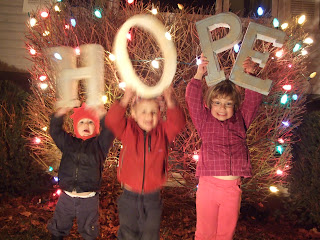
This is a shot from our Christmas card picture trial, Take One. Marginal success. But it was fun.
Hope this finds you warm and cozy with the scent of fresh winter greens somewhere nearby (except spruce, I don't like spruce).
Monday, November 26, 2012
December here yet? :)

Well, it feels like it's been a long time coming, but it's here and tomorrow we pack up to head all the way down to Charlottetown for the National Outstanding Young Farmers event and although I have mixed feelings right now, I know it'll be an amazing time. I say mixed feelings right now because I've got at least three ewes in the barn looking very 'baggy' and heavy and tired, and because we've never been away from the kids (or the farm) as long as we will be this week. I spent a long time snuggling everyone to bed tonight, knowing it would be a while before I could do that again. But we've got them spread amongst some people who really love them while we're gone, so I doubt they'll even notice our absence much.
The ACORN Conference this past weekend was really great as usual and it turned out be really fun to have kids with us in the hotel. A lot more work of course, but fun to have them there enjoying it all. There is a GREAT childcare service and they had a fun time with that which left us time to get to some interesting workshops. Although as I said to Mark I almost feel like the networking and chatting outside of the workshops is nearly as, if not more, valuable. It is always so nice to come away feeling invigorated and positive about what we're doing when there are times we wonder. Thanks ACORN for putting on a great and huge event!
Big thanks to both of our parents and Mark's sister, Martha, this week as they tackle the challenge of the three wee ones. Extra thanks to Wendell for so willingly stepping into being a shepherd and keeping a general eye on things while we're gone. And to awesome neighbours who will milk Rosie for us for most of the week. And to my Dad who will take over milking when he gets here (despite his less than enthusiastic love of Jerseys). And to Mom who will relieve my lambing worries once she arrives. And to Patty Jo who will check in on the 'girls' for me during the week before Mom gets here.
I'm sure that by Sunday all of the above will be questioning the wisdom of our latest announcement: Bernard number 4 will be arriving June 2013.

Here's to successful lambings, with no problems. Or better yet, no lambings until next week!!!!
I hope this finds you looking forward to a December filled with traditions, eggnog, music, relaxation and family. I know I am.
-Sally
Sunday, November 11, 2012
Why False Organic Claims Matter
If the product is raised on pasture, locally, by farmers I know, fed feed from a local mill and sold at my farmer's market, what difference does it make if the organic claim is legitimate or not?
A lot.
There are a few key factors involved in this somewhat loaded question and I'd be lying if I didn't admit that this particular entry is inspired by some serious (and repeated) false organic claims made by La Ferme Springbrook, based very near to where I grew up. The Times & Transcript (Moncton, NB daily newspaper) recently featured a piece on the farm, with pictures of their chickens including a claim of certified organic status and even a statement from Paul, the owner, suggesting that he was organic before organic was even a 'thing'.
I've never been to the farm, and when I looked them up online, I was struck by how similar many of their pictures look to ours. They've got meat birds out on pasture in movable pens similar to ours, and layer hens running around in the grass. They've got lambs with long tails and some very pretty landscape shots. It looks like a great little farm, trying to do all the right things.
It has come to my attention before, that at their stand at Dieppe Farmers Market, there are visible organic claims and nothing to substantiate it. So when I was at a meeting this summer and happened to be sitting across from Paul, I took the opportunity to ask him about his organic claims. He gave me a quick well-heeled explanation of how they do things 'naturally' and that it really is organic, but they don't have the certificate.
"So where do you source your grain and feed?"
"Miramichi Feeds. It's a good mill."
"And would contain a fair bit of soybean and corn I suspect, right?"
"Yes."
"So those would be GMO, right Paul?"
"Well, I don't know about that."
"Ok, well, let me confirm for you, that unless it's organic feed, which I know Miramichi Feeds don't make, that it is with certainty, GMO feed."
stutter, briefly, " It is good, local feed, I have bought from them for years and years. I've never had a problem."
I am still unsure as to whether he really didn't understand the concept of GMO's or whether he was dodging a reality here, but either way, I feel the need to clear up just exactly why this deception doesn't just hurt the organic community, it hurts agriculture and in particular the buy local movement.
1)the cost of grain is without a doubt, the #1 prohibitive reason for people considering livestock, organic or not. Organic grain continues to be considerably more expensive than conventional and those who make the effort, pay the big bucks and suffer the challenges of supply, sourcing and paperwork have earned the extra level of credibility. They have taken the extra step in ensuring that the nutrition they are providing for their livestock is confidently, GMO-FREE! Be it for ethical reasons, scientific reasons, marketing reasons or personal reasons, they have chosen to bear the burden of the extra cost and likely hope to recoup some of that cost by marketing their product as legitimately, truthfully, certified organic.
2)Consumers want to do what's best for them and their families. If they are making the effort to come to the farmer's market they are already a step ahead, a demographic concerned about the sources of their food and wanting to support a good, local product. They WANT to believe that friendly looking face behind the counter and to take that trust for granted, by deliberately telling mis-truths hurts every other farmer out there. I don't have a problem with local, not-organic food. If you can trust your farmer and you are happy with the product you're buying, at the price you're paying, then please enjoy and consider those producers each time you cook whatever it is you've purchased. I WANT people to have their own farmer, just like they lay claim to a doctor or a hairdresser. I WANT there to be a trust between those who grow our food and those who eat it. But I'm struggling with creating a trust over a product whose label doesn't live up to reality.
3)Not everyone who learns the truth will care. Many won't. But some will. And those who will, will understandably have a difficult time trusting another farmer again. Be they organic or not. And not just the farmer, but logo, the standard, the label, ruining it not just for another organic farmer at that market, but for organic food across the country. CFIA is supposed to be the body responsible for investigating false claims, but with spotty (read:none in most cases) provincial regulations and fewer and fewer resources, it's simply not something that gets done as often as we'd all like. So it comes down to organic inspectors (who only inspect organic farms) and the individual consumer. It simply isn't a fair way to treat people who are your bread and butter.
There is growing interest over "GMO-free feeds and products", which is to say they are not organic, so don't necessarily hold the other standards of animal welfare, environmental impact, etc. etc., but THAT is a fair claim in my eyes. Once again, the farmer is making the extra effort and paying the extra money to source a product outside of the conventional, GMO system and although they may not be certified, it doesn't matter, because THEY'RE NOT CLAIMING TO BE.
If Paul's ignorance about the significance of GMO's is truly based on just that; ignorance, then I guess it is up to his customers to demand a change. As far as I am concerned, in this day of national organic standards and a public who is generally aware of what that means, it is absolutely, undoubtedly unacceptable to be feeding a prohibited substance as part of the daily diet of livestock and unabashedly use the certified organic claim.
In one way, I hate being the bearer of news like this, because if even one of Paul's happy customers read this and actually care, then I've just been the carrier of the confusion and mistrust. I just laid the trail of evidence which leads to someone potentially turning their back on local agriculture at all, and returning to the anonymous grocery store shelves. Or maybe I've just cleared up some questions and caused someone to think, "Hmmm...well, I guess next time I'll ask for an up to date organic certificate, or ask that farmer about what she feeds her animals and won't take a vague, pretty sounding explanation in response."
Probably not, but if there's even a small chance, then it was worthwhile potentially alienating someone with this entry. This thing wouldn't be much fun for anyone if I couldn't be honest, would it?
I am getting really excited about the ACORN conference coming up. If you're at all interested in anything organic, you should really check out the program, which is jam-packed with awesomeness. Although it is guaranteed to be a busy time for Mark and I, I always look forward to that feeling I come away with of assuredness in what we're doing and confidence that this is the right track. And soooo many ideas. And for the first time we're bringing the kids to much of it and I'm kind of excited for their first hotel experience (it helps that it has a pool).
http://acornconference.org/
I had a bit of trouble today for the first time, with pregnancy toxemia in a ewe, who I don't think is going to make it, despite a very pricey visit from the vet on a holiday Remembrance Day. It has given me pause and is probably the unfortunate wake up I needed to re-prioritize a few things. Lambing is due to start in the next week or two and will likely hold off until Mark and I have been trucked down to Ch'town for our week-long National Outstanding Young Farmers event. I have been losing sleep over this single fact for a few nights now, but at this point there is very little I can do, so I'll just cross my fingers and hope they all go overdue and wait until December.
I hope this finds you anticipating a long, snowy winter, full of cozy warm drinks and perhaps pretty seed magazines to browse. Ah, sounds like heaven right now.
-Sally
A lot.
There are a few key factors involved in this somewhat loaded question and I'd be lying if I didn't admit that this particular entry is inspired by some serious (and repeated) false organic claims made by La Ferme Springbrook, based very near to where I grew up. The Times & Transcript (Moncton, NB daily newspaper) recently featured a piece on the farm, with pictures of their chickens including a claim of certified organic status and even a statement from Paul, the owner, suggesting that he was organic before organic was even a 'thing'.
I've never been to the farm, and when I looked them up online, I was struck by how similar many of their pictures look to ours. They've got meat birds out on pasture in movable pens similar to ours, and layer hens running around in the grass. They've got lambs with long tails and some very pretty landscape shots. It looks like a great little farm, trying to do all the right things.
It has come to my attention before, that at their stand at Dieppe Farmers Market, there are visible organic claims and nothing to substantiate it. So when I was at a meeting this summer and happened to be sitting across from Paul, I took the opportunity to ask him about his organic claims. He gave me a quick well-heeled explanation of how they do things 'naturally' and that it really is organic, but they don't have the certificate.
"So where do you source your grain and feed?"
"Miramichi Feeds. It's a good mill."
"And would contain a fair bit of soybean and corn I suspect, right?"
"Yes."
"So those would be GMO, right Paul?"
"Well, I don't know about that."
"Ok, well, let me confirm for you, that unless it's organic feed, which I know Miramichi Feeds don't make, that it is with certainty, GMO feed."
stutter, briefly, " It is good, local feed, I have bought from them for years and years. I've never had a problem."
I am still unsure as to whether he really didn't understand the concept of GMO's or whether he was dodging a reality here, but either way, I feel the need to clear up just exactly why this deception doesn't just hurt the organic community, it hurts agriculture and in particular the buy local movement.
1)the cost of grain is without a doubt, the #1 prohibitive reason for people considering livestock, organic or not. Organic grain continues to be considerably more expensive than conventional and those who make the effort, pay the big bucks and suffer the challenges of supply, sourcing and paperwork have earned the extra level of credibility. They have taken the extra step in ensuring that the nutrition they are providing for their livestock is confidently, GMO-FREE! Be it for ethical reasons, scientific reasons, marketing reasons or personal reasons, they have chosen to bear the burden of the extra cost and likely hope to recoup some of that cost by marketing their product as legitimately, truthfully, certified organic.
2)Consumers want to do what's best for them and their families. If they are making the effort to come to the farmer's market they are already a step ahead, a demographic concerned about the sources of their food and wanting to support a good, local product. They WANT to believe that friendly looking face behind the counter and to take that trust for granted, by deliberately telling mis-truths hurts every other farmer out there. I don't have a problem with local, not-organic food. If you can trust your farmer and you are happy with the product you're buying, at the price you're paying, then please enjoy and consider those producers each time you cook whatever it is you've purchased. I WANT people to have their own farmer, just like they lay claim to a doctor or a hairdresser. I WANT there to be a trust between those who grow our food and those who eat it. But I'm struggling with creating a trust over a product whose label doesn't live up to reality.
3)Not everyone who learns the truth will care. Many won't. But some will. And those who will, will understandably have a difficult time trusting another farmer again. Be they organic or not. And not just the farmer, but logo, the standard, the label, ruining it not just for another organic farmer at that market, but for organic food across the country. CFIA is supposed to be the body responsible for investigating false claims, but with spotty (read:none in most cases) provincial regulations and fewer and fewer resources, it's simply not something that gets done as often as we'd all like. So it comes down to organic inspectors (who only inspect organic farms) and the individual consumer. It simply isn't a fair way to treat people who are your bread and butter.
There is growing interest over "GMO-free feeds and products", which is to say they are not organic, so don't necessarily hold the other standards of animal welfare, environmental impact, etc. etc., but THAT is a fair claim in my eyes. Once again, the farmer is making the extra effort and paying the extra money to source a product outside of the conventional, GMO system and although they may not be certified, it doesn't matter, because THEY'RE NOT CLAIMING TO BE.
If Paul's ignorance about the significance of GMO's is truly based on just that; ignorance, then I guess it is up to his customers to demand a change. As far as I am concerned, in this day of national organic standards and a public who is generally aware of what that means, it is absolutely, undoubtedly unacceptable to be feeding a prohibited substance as part of the daily diet of livestock and unabashedly use the certified organic claim.
In one way, I hate being the bearer of news like this, because if even one of Paul's happy customers read this and actually care, then I've just been the carrier of the confusion and mistrust. I just laid the trail of evidence which leads to someone potentially turning their back on local agriculture at all, and returning to the anonymous grocery store shelves. Or maybe I've just cleared up some questions and caused someone to think, "Hmmm...well, I guess next time I'll ask for an up to date organic certificate, or ask that farmer about what she feeds her animals and won't take a vague, pretty sounding explanation in response."
Probably not, but if there's even a small chance, then it was worthwhile potentially alienating someone with this entry. This thing wouldn't be much fun for anyone if I couldn't be honest, would it?
I am getting really excited about the ACORN conference coming up. If you're at all interested in anything organic, you should really check out the program, which is jam-packed with awesomeness. Although it is guaranteed to be a busy time for Mark and I, I always look forward to that feeling I come away with of assuredness in what we're doing and confidence that this is the right track. And soooo many ideas. And for the first time we're bringing the kids to much of it and I'm kind of excited for their first hotel experience (it helps that it has a pool).
http://acornconference.org/
I had a bit of trouble today for the first time, with pregnancy toxemia in a ewe, who I don't think is going to make it, despite a very pricey visit from the vet on a holiday Remembrance Day. It has given me pause and is probably the unfortunate wake up I needed to re-prioritize a few things. Lambing is due to start in the next week or two and will likely hold off until Mark and I have been trucked down to Ch'town for our week-long National Outstanding Young Farmers event. I have been losing sleep over this single fact for a few nights now, but at this point there is very little I can do, so I'll just cross my fingers and hope they all go overdue and wait until December.
I hope this finds you anticipating a long, snowy winter, full of cozy warm drinks and perhaps pretty seed magazines to browse. Ah, sounds like heaven right now.
-Sally
Subscribe to:
Posts (Atom)