Wednesday, May 1, 2013

Science? Barf.

Anyone who knows me, knows that I have always struggled with science and math. Just saying the words 'chemistry' and 'calculus' make me nauseous.  Even if you don't know me, you might make the assumption that my Bachelor of English degree is an indicator of a stronger right brain than left.  (You're right.)
I've realized that it's too easy to surround oneself with their own opinions.  I mean, in this social media world where I can link to anyone, anywhere, I naturally lean towards anti-GMO websites or organic organizations on Twitter.  I want to stay on top of the headlines that interest me and staying within my interests is the best way to do that right?  But recently I've discovered that it's even more interesting to stay on top of headlines that interest me by following those who I disagree with most.  It's irritating and causes me to lose sleep thinking about it, but it's kind of refreshing in a maddening sort of way to hear a GMO debate from the other side and listen to the commentators put down organics.  After months of reading the Tweets and comments, I have noticed a recurring trend.  Firstly, that organic producers and their advocates tend to dismissed as uneducated and always naive.  Secondly, that the reason organic producers are naive is because they 'don't understand the science', or 'don't accept the science'.  Science keeps coming up as the be-all, end-all of everything everyone needs to know about the benefits of GMOs.  As if there is no discussion to be had because clearly, science has laid out the answers and any opposition is simply not worthy of hearing, because it's not based on science.
Here's the trouble:
Science is not infallible.  From beginning to end, it is interpreted, executed, reported and utilized in specific ways to reach specific means.  I could point to the 'science' that promoted DDT or asbestos as life-savers and the next best thing to make life easier and HEALTHIER.  Or I could point to the 'science' that led and continues to lead many parents to not vaccinate their kids based on a still controversial study that linked autism with a specific vaccine. But since we're talking about GMO science, let's stick with that.
Firstly, it's well known and documented that chemical companies are some of the biggest sponsors of several respected universities who invest significant resources into 'scientific studies' regarding all kinds of things.  Even if the science is done perfectly, following pristine methods, the results can be tucked away if not agreeable.
But often the methods aren't pristine.  Take a simple trial on PEI, for example.  Researchers who work at a federal research facility invest their time and our resources into 'organic trials', but plant the trials in land that was potentially treated conventionally as recently as last year.  Even if the trials are treated organic, to the letter, for the year of the trial, it's not an accurate representation of what organic soil is capable of.  If it's a variety trial for example, maybe a variety has been bred for use in a conventional system, planting corn for 5 years in a row (ugh....but entirely possible), or maybe it's an organic variety that when planted in poorly managed soil does poorly because it has been bred for more organic matter, or lots of mycorhizzae or whatever it is that is unique to it's make-up.  That's just one TINY example of how what could possibly be reported as an 'organic variety trial study' could be wrong and terrible from the start.
There is an interesting story of a study done that questioned the benefits of GMOs and in the end was critical.  It was published in scientific circles and then the New York Times caught wind of it and planned to put it their weekend paper.  In these days of suffering newspaper sales, their biggest advertiser, the chemical company responsible for the product questioned in the study, threatened to pull all of their advertising money if it was published.  That weekend paper did not publish the study and instead, had a full page ad for the company in question.
So, even if the science is right, how it's reported or distributed can be often and easily skewed.

The moral of the story is, I'm tired of "science" being shoved in my face as the answer to the world's problems.  It's important, yes. I recognize that.  But it's as fallible as the observations a farmer can make with their eyes on a day to day or year to year basis, and even more susceptible to skewing.

Finally, can we all just stop referencing the now ancient notion that GMOs will lead to farmers using less pesticides?  If science hasn't proven this, the bottom lines and margins of chemical companies prove otherwise.  So for all the other reasons that GMOs are supposedly going to save the world, let's agree to leave that bullshit where it belongs- in the defunct pile.

For those of you who made it this far and have been asking for pictures, here's a few that I finally cleaned off my camera today.
 
The trio on Easter morning in their Sunday best, full of chocolate and ready to sit quietly in church. bahahah!
 
Me indoctrinating Lucy with anti-GM alfalfa propaganda on April 9th, the national Day of Action, which happened to coincide with a highschool culinary class tour of the farm.


 This is the beast, otherwise known as Mark's preoccupation for the winter.  A fancy shaker cleaner that does a pretty great job, but will do an even better job when it gets a cyclone that keeps the light chaff in check.
 
This is a scene from today- May 1st, 2013.  I looked out to the sandbox to find no kids.  Further investigation found them in a much bigger sandbox, a freshly tilled field, Tonka's working at full bore, manure spreader and discs in the background just to help set the tone of 'serious work'.  Oh, and completely naked too of course.

It's way too dry here.  Drier than ever, let alone for spring.  But I admit that today's sun was pretty spectacular.  So I won't complain either way, but if I was a good farmer's wife, I'd say WE NEED RAIN!

Hope this finds you digging in some sort of dirt.

-Sally
        

Thursday, April 18, 2013

Political Patriotism

Ever since I've moved to PEI there's a news story that keeps coming back up over and over that continues to surprise me.
Every once in a while there will be some high level appointment or back room deal in which a well-known supporter of whichever government it is comes out the winner.  And there is usually a big stink made on the news about political patriotism and favoritism and how this isn't fair, etc. etc.
I'm always confused because I grew up in a community that basically relied on political patriotism and those who showed their 'colours' were rewarded when the opportunity arose.  It was, and is, part of life.  Be it a significant contract, a work term, or one day's backhoe work, if you're on the 'right side of government' your chances are much better. 
So I'm always surprised when PEI makes a kerfuffle about this sort of thing.  I've taken it for granted that it's a fact of life and it's a choice whether to support one or another party or to appear to remain neutral.  I fully understand the benefits of being a visible and well-known supporter, but have also seen the negatives of being on the 'wrong side' as well.
It's also taken me a while to get used to the fact that Mark's family isn't particularly involved in politics.  They vote and are probably more informed than many, but there is no 'colour' associated with them.  Where I come from, it's not a Sunday dinner or Saturday evening chat without some political banter of some sort.  And it's not like I've shied away from sharing my political views on this blog either. In fact, I think I've been fairly explicit in some cases, if not sharing my preference, certainly exposing the ones I hate the most.  I'm sure if you searched "Dead Shark Eyes" within this blog alone, you'd come upon more than one entry of a rant of mine regarding the 'current administration' as they are often referred to.
So imagine my surprise when we got the call to be the sight for an announcement to be made by the federal Minister of Agriculture for the national ag. funding program (Growing Forward 2).  My first thought was, "Who is doing the vetting these days!??!"  My second thought was, "No way.  We're not hosting this.  Everyone will think we're Conservatives!!!  GAH!!"  My third thought was, "Is Mark a secret member of the party!?!!?  I can't sleep with a Conservative!?"  (no, I didn't really think that.  there's no way a Conservative-even a secret one- could put up with listening to me and my rants everyday.)
I had several trains of thought following those, but I'll share those another time.
For now, I'm off to get my beauty sleep so that I'll look good on camera tomorrow (filmed chatting to Minister Ritz about GM alfalfa), and have patience to deal with all the handlers and minions who will be running around 2 hours beforehand trying to make a farm look like just the right kind of farm for a backdrop.  I'd like to watch them try to herd the roosters into a convenient spot.
I sincerely hope that Rosie doesn't get out like she did the other night and run completely a muck all over the farm, looking like a big pregnant rodeo bull, with her giant belly swaying heavy with each kick and triumphant jump.
Although that would certainly make the (likely otherwise pretty dry) day more interesting I'm sure. :)

I hope this finds you thinking about your own 'political affiliation' and how that might be expressed, unbeknownst to you.

-Sally


Monday, March 18, 2013

Mad about Food

Seems like just lately, people are finally getting worked up about the GM salmon I wrote about a couple years ago (yeah, that's a little disappointed smugness).  Many people, who I don't think realize how many other GMO's they're eating on a regular basis have taken on the salmon battle.  We often tend to think in concrete, one dimensional ways about our food, so it's easy to tell ourselves that we don't eat soy, or sugar beets, so we're not part of the GMO experiment.  Sadly, as I've oft pointed out here, 70% of food in the grocery store contains genetically modified material.  But it's much sexier to battle it out against a giant salmon than a cotton ball (also GM), so it's getting a bit of attention right now.  I'd like to suggest however, that there is a far larger threat to our food system than that terrible fish, but it's probably the least exciting crop and feels the farthest from our plates, so may take some time (which we don't have) to get the attention it deserves.

Alfalfa.  Unless you eat sprouts on sandwiches, chances are, you're thinking "I don't eat alfalfa, that's rabbit food."  Well, unless you survive solely on a diet of organic vegetables grown in your own garden, you're bound to be part of the GM alfalfa experiment.
Alfalfa is that pretty blue flower you see in lush looking pastures about the same time that the pink clover is flowering.  It's a legume, so fixes it's own nitrogen and is a particularly nutritious forage for cattle.  It is a bit rich for sheep, but they love it and we recently incorporated it into our newest pasture.  It doesn't make great hay because the leaves are smaller and tend to fall off by the time it goes through a rake, tedder and baler, but it makes beautiful silage and haylage and is a key component to the diet of dairy cattle.  Alfalfa is extremely common across the country and (here is the important part) is a happy hunting ground for bees on the look out for pollen.  The flowers are close together and easy to access and you might actually see honey labelled as 'alfalfa honey' from time to time.  And when bees get involved, well, things can get messy.  So far, corn pollinates itself, via the breezes, and soy doesn't require pollination, so the bees have been, for the most part, able to stay out of the GM battle (although let's be clear, not unaffected as they're enduring the lasting affects of the associated pesticides).
So, the wee bees, unknowingly foraging away in what seems a benign, beautiful alfalfa field, buzz back and forth for as far and wide as they please (1-5 kms) and take GM alfalfa pollen to a not-GM alfalfa field and....oops whaddya know...now we've got two GM alfalfa fields.  It is the same as us not being able to grow organic corn here in Freetown due to our proximity to many GM corn fields due to the cross pollination that could happen by the wind, except that bees travel much farther than corn pollen and they are much more exacting with their transfer, nearly guaranteeing a cross-contamination, rendering an entire field GM contaminated.  And since alfalfa is a forage (and not a cheap one), it can be left in rotation for multiple years, as it is a perennial crop and will continue to come back with good soil health management.  So now, we've got a field accidentally turned GMO and it will remain that way for a few years to come and bees will continue to frequent it and it then becomes a new source of GM pollen to pass along to the next field.

So what?  Think this still doesn't affect you?
 Here's just a few of the ways it could:

Conventional Meats: Chances are, unless it's organic, the grain it eats is GM anyway (soy and corn) so maybe the threat of alfalfa seems pretty minor, but do we really need to add another GM element directly to our food system?  Feedlot or pasture-raised, all ruminants (beef and lamb) receive a significant portion of their diet from a forage and in many cases, alfalfa will play a part in it. 
  
Grass-fed meats (beef, lamb, etc.)- aim to feed that concerned eater market who want to avoid grain-fed products for a variety of reasons (GM potential, more natural for ruminants to not eat grain, better for the environment, etc.) It would be difficult to maintain a very 'natural' air about grass fed beef, if the likelihood of GM alfalfa in the diet is a near guarantee and beyond control.

Organic dairy-  Dairy is probably the commodity that makes the most use of alfalfa and organic dairy is no different.  Since bees don't understand field limits, contamination is capable for many kilometers and again, beyond the control of the farmer.  So while the farmer may be following every organic 'rule' above and beyond requirements, the very pasture the cows are grazing on could be their undoing.  And if you question the importance of having an organic dairy industry, just ask Quebec.  That agriculture-rich province, at their annual general meeting of all types of producers, just passed a motion essentially banning GM alfalfa from the province.  This was born from a movement within their lucrative organic dairy community, but was supported by everyone.

Grains- we use legumes like clover as part of our rotation, because they grab nitrogen from the air and hold it in their roots so that when we plow them in, they serve as a source of fertility that we would otherwise be unable to access.  Remember how I said alfalfa is part of that legume family?  We often trade a cut of our green manure crop with a neighboring dairy farm in exchange for some actual manure.  Two problems: 1)we might someday choose to incorporate alfalfa into the mix with our clover for variety, and to make our dairy farmer neighbour extra happy (although given the price of it, likely not) and 2)his manure that we've traded for now has that much more GM contamination from the cattle eating a GM forage.

Vegetables- in order to keep soil healthy it must go through a rotation, involving different crops. Rotation prevents disease and pest populations, encourages diversity in the soil, prevents erosion problems and a huge host of other benefits.  Often a legume is a chosen rotation crop because of the afore-mentioned nitrogen fixing.  If it's organic, it's going to be that much harder for the organic farmer to maintain organic standards on land that is threatened by GM contamination.

So, let's say you've decided to not care about GMO's or worry about their threat to human health and our environment, why is this one any different? 
It doesn't offer any benefit. To anyone.  Even the GMO-loving, bio-tech-thirsty conventional, yield-over-all-else big-ag farmer will find marginal benefits from using this crop.  I have no idea how many farmers routinely spray their forages, but I have never in my life seen one do it, or heard of it as a common practice.  In organic and grass-fed circles, it is actually a benefit to have a diversity of plants in a forage mix.  Perhaps you have heard of Joel Salatin's "Salad Bar Beef" branding that he shares, suggesting that a variety of different plants on a pasture all bring different nutrients and benefits to the table so that the livestock have more choice and receive more benefits from what they're eating.  Spraying an alfalfa field would eliminate virtually EVERY other thing in the field, leaving a monocrop.  I guess the perceived benefit of this would be ease in calculating the nutrient density of a silage (and a TMR) and would alleviate weed pressure the following year, but forages are always plowed in anyway, so it seems like a waste of spray dollars.  Or at least hardly an investment of money and time that pays for itself in the end. 
The other crazy part of GMO's that we never talk about is the essential ingredient that makes them work and that's Round Up (glyphosate).  It's seen in most circles as the least harmful of all the pesticides but there are increasing studies and observations that consider its use over time that are showing some really serious problems with soil health.  And even more than bees, our human survival relies entirely on healthy soil. Effects of Round Up deserves it's own blog post, but I won't bore us with that now.

But Monsanto isn't stupid and they have proven time and again how to rope farmers into cycles of relying on them for seeds and chemicals and signing away their rights at the same time.  Given the history of court cases of farmers being sued by Monsanto for having GMO seeds in their crop, due to accidental contamination (and winning!) this poses a threat in the form of uncontrolled contamination and the potential for all kinds of unwitting farmers falling under corporations rules and punishments.

So,the next time you eat something, think about how it could be affected by this seemingly distant and innocuous crop and think about how the farmers you know might be threatened by things entirely beyond their control.
Here's a website with some ways to get involved:
 http://www.cban.ca/Resources/Topics/GE-Crops-and-Foods-Not-on-the-Market/Alfalfa/Day-of-Action-to-Stop-GM-Alfalfa-April-9

 I've posted this little cartoon video before, but I'll post it again:  

I hope you've got your seed orders in and are looking forward to the growing season not-so-slowly creeping up on us!!

-Sally

Monday, February 18, 2013

Anyone left out there?

Well, I truly doubt if I have any followers left, so I'll just send this out into the internet-oblivion to prove to myself that I can still indeed write blog posts.  Whether they are worth reading is something else all together.
Too much has happened since I lost posted so here's a few highlights:
1)  I sold my sheep.  Well most of them. I couldn't part with them all, so I kept four ewes (which is a torture as far as Mark is concerned), but I sold the rest.  They are due to lamb any day and I have to say, knowing that, makes the decision seem like a really good one right about now. 
2)  I've been coaching at derby which is way more fun than I anticipated and am considering doing a bit more of while I'm unavailable for skating.  I am bench-coaching at a game this weekend so that will be a good test, under pressure to see how much I actually like it.
3)  The senate has gone to pieces.  Seriously.  What is wrong with these people?  Harper couldn't find a single Islander to appoint back when he plucked Duffy out of the fray?  Well he won't have much more luck around here after this debacle, along with the EI changes and Shea's lack of represenatation for her own consituency.
4)  I attended the Organic Value Chain Roundtable meeting in Ottawa, which was a bit overwhelming but very interesting.  Although not really a top agenda item, the thing that had me most interested was that Quebec managed to pass a resolution at their UPA (basically the entire agricultural producers organization for the province) AGM essentially banning GMO alfalfa from being grown in the province.  It sounded to me like they sent out information to all grain producers informing them of the threat that GMO alfalfa would bring to the organic dairy industry, which (I think) helped ease the way for the resolution at the meeting.  They admitted that there was some resistance in the grain corner, but they compromised by removing the word 'moratorium', which is longer term and very final.  Even a baby step in the direction of acknowledging the threat the GM alfalfa holds is a significant recognition to GMO's in general I think.  Anyway, the whole meeting was interesting, but I was really taken with the progressiveness of Quebec on that particular subject.
5)  Mark has been spending every spare minute on his new grain cleaner.  It's bigger and better and is going to run like butter whenever he gets it going (if the parts and invoices keep on their current trajectory anyway). 
6)  We've decided to switch to an outdoor furnace for heat next year.  I am anxious.
7)  I finally caved and registered Lucy for school in the early immersion program.  I lost a lengthy battle with the district over busing the late immersion school, but I figured I'll choose my battles and there will be more, and important ones to come.  (Which, if you're from the district, know that I pulled my horns back only to sharpen them up for the next round so don't be so rude to me next time.)
8)  Rosie is due in May so we're getting ready to dry her off.  We've got a couple weekend engagements coming up in early March, so we're drying her off a little early to save having to get a relief milker.  It seems like a good idea right now, but I may wish we hadn't when I have to start buying milk again.  Thankfully, Mark geared up a great electric milk separator a couple months ago so we've had skim milk and cream lately.  I've planned ahead and have several pounds of butter in the freezer.  Here's hoping it's enough to get us through to May!
9)  My resolution of getting up before everyone else has been a bit of a failure, but I've new resolve now.  I'm going to give it another go.  I'll probably just be getting a schedule down as the new arrives to throw it all off again.
10)  Despite a couple prolonged cold snaps, the chickens are still laying so we have lots of eggs! 

What finally brought me back to the blog is something that has bothered me...well pretty much ever since I started attending meetings having to do with agriculture.  The word 'efficiency' has been touted as the savior of agriculture and the world ever since I can remember.  If only farmers could increase their efficiency, we'd all be better off.  Right?
Here's a couple of ads put out by an organization called Agriculture More Than Ever, which I think has something to do with Farm Credit, but that's not explicit in any of thier info, so we'll be naive and assume they are some independent organization set up to make everyone feel good about agriculture.  And they do a good job. 

Don't you feel warm and fuzzy?


Well, let's look at these another way.
Firstly, how many people can't consume wheat products anymore?  The current gene pool for modern wheat is so shallow and specific that the things that used to make wheat palatable and healthy for us have been bred out to make way for 'efficiency'.  Old fashioned wheat maybe doesn't yield as well, or maybe it's more susceptible to disease or matures too slowly.  Some traits that don't suit the big-ag, food processing giants have left us with near generations of individuals who have now crossed 'gluten' off their list of things they can eat without discomfort.  At the ACORN conference in November, the bread baker used Speerville organic flours, made from older wheat varieties, grown here in the Maritimes.  A woman attending the conference who typically could not consume wheat, ate the bread without problem. 
So congratulations big-ag, you're super efficient at producing wheat.  Too bad so few can enjoy it.

The second ad builds up the value of efficiency so much that it fails to acknowledge some of the big differences between the state of our land in 1950 compared to today.  In 1950, the soil and its inhabitants had only just begun to deal with the assault of years of pesticide use.  Giant factory farms and feedlots were not yet a norm of food production.  Environmental degradation, including water, air and soil quality were not a regular part of the discussion of producing food- and not necessarily because they weren't considered important.  Perhaps we simply have more reasons to consider them now.  "...with less land and fewer resources."  This sounds like it's straight out of a GMO advertisement for a variety of corn that withstands dry periods better. 
I think I'm the most annoyed that they threw the word "sustainable" in there.  How many studies have to be done showing that small-scale, organic based systems are more sustainable in the long run before we start to acknowledge and support for THOSE systems. 
It's sort of like that much-discussed ad from the Superbowl, by Dodge Ram, using that old Paul Harvey piece called, "So God Made a Farmer".  It's touching and it brings me to tears everytime, because the farmer described in the piece is exactly the kind of farmers I grew up around, and married and aspire to be.  But they are so rare in the big picture of today.  And it's not fair to play that for North America and pretend that those images and those descriptions are accurate to how we're fed today.  A more accurate ad would have had pictures of factory farms and long lines of carcasses in mega abattoirs, and processed foods and people in board rooms selling seed and buying feed based on some futures market 2 years down the road.  It makes everyone feel better about the weird processed ham product they put in their kids sandwich and continues the lie of healthy food that we're fed by big-ag, taking advantage of the cutesy small town feeling of yore.
I am glad that God made a farmer. And I'm glad that two raised me, and that I married one.  I'm just sad that more people don't have that luxury and don't know what they're missing.
  
Glad to be back.  Hope this finds you putting yourself back on the follow list. :)

-Sally

Friday, January 4, 2013

Bittersweet New Year

It is with a heavy, but contented heart that I write this post.  I've been thinking, mentioning and agonizing over this decision for a long time now and it feels a bit liberating to have finally made it, once and for all.
I am selling most of my flock.  I am going to keep the four ewes who just lambed, but will be putting the other 9 up for sale later today.
Mark was more resistant to the idea than I was and I feel like I spent the last couple months just wearing him down.  He even at one point suggested that if I would raise them, he would take on the marketing and selling which are the two bits I hate the most.  As if he doesn't have enough on the go.

But he's finally agreed that it's for the best right now.  For the past two years, I have simply not been able to dedicate the time that I need to, for optimum management of an organic flock.  And I feel like I've been suffering the consequences with recent incidents in the flock, that most likely could have been prevented with me taking a keener interest in the everyday goings on. 

Mark and I are both disappointed that we feel the flock has finally gotten to it's prime organic state in terms of parasite thresholds, resistance and management.  They are in the best condition I've seen them and lambs that I've raised under organic standards are now on their second or third lambing.  It's a satisfying labour of love that is difficult to say goodbye to, but as I continued to insist to Mark, we can undergo the same adventure in a few years when we are ready and better able.

SO, with that, I've got nine beautiful, purebred, registered polled Dorsets, bred to a North Country Cheviot ram who has consistently thrown healthy, quick-growing lambs for three years, for sale.  They are certified organic and excellent mothers.  Most were born in 2009, with the oldest born in 2007.  All have lambed, except one yearling I purchased at the Canadian Classic last summer who is marked to lamb along with the rest, starting around Feb. 14th.  All are marked to lamb at that time within a month. 

Although sad to see them go, I am even happier to let go of the guilt that has been nagging me about lack of vigilance and adequate management.  Looking forward to the coming years when I can create a proper business out of a new flock with a new, fresh perspective on it all, and the time necessary to do so.

Hope this finds you prioritizing for this new year and perhaps simplifying your own life in lieu of 'doing it all'.

-Sally

Sunday, December 16, 2012

For the Love of Life


I've been eager to get on here and write about the latest W5 episode regarding factory farming, in particular in the pork industry in Canada and some of the hidden camera footage taken in a hog barn in Manitoba.  I've been reading several responses from people within the pork industry and every one of them has been less-than-satisfactory as far as I'm concerned, but one in particular caught my eye.  It was the response from a large-scale hog producer who basically said that although the footage was perhaps taken from a less-than-perfect farm, the procedures (castration without anethesia, farrowing crates, etc) are all pretty standard fare in the industry as a whole.  His bottom line however was that although he appreciates human treatment of animals, what really drives him is his 'desire to feed the world'.  And it's because of that desire to feed people that he produces pork like he does. Basically he put the responsibility on the consumer who continues to demand cheap food. 
It was curious to me that what I interpreted was that he would rather raise them a different, perhaps better way, but given the pressures of economic reality and consumer demand, he is forced to confine sows to crates for life and raise weaners on slated floors in a crowded, closed buildings, feeding cheap GMOs and lots of antibiotics to keep them 'healthy'/growing.  So who's responsible for it?  The consumer?  The farmer?  I just thought it was an interesting pass of the buck.  

But refreshing to see that he didn't deny the legitimacy of the piece, although slightly sensationalized. Too bad the show likely won't make any difference to 99% of pork buyers. 

I've been in the midst of lambing, although that gives the impression that it's a thrill of action in the barn, lambs left and right.  In reality, it's just me checking ewes late at night and early morning in anticipation of action and one arriving every week and half or so.  The first one arrived on December 2nd and there have been three lamb since.  Yawn.
Last night was perhaps the most eventful lambing to date, for me personally.  The ewe had been acting strange all day, but not showing any distress or physical signs of much of anything.  By late last night I decided it was time to investigate, to discover a lamb turned completely backwards and legs tucked right up front.  Hearing echoes in my head from all my British friends claiming that pregnant women should never handle unborn/dead lambs (due to abortive diseases that can pass between ewe and woman), I gave one good try at figuring out the mess inside, but was unable to make heads or tails of it (ha! I think I just discovered the origin of that phrase!)
Anyway, thankfully my fearless husband, who grew up without livestock and has bravely jumped headfirst into animal husbandry was able to get in far enough (shoulder deep), with enough strength to get the huge lamb pulled out.  Both it and it's twin that followed were dead, due mostly to our having not intervened earlier I think. 

But it was while I was having the emotional struggle of pulling this lamb I knew would be too big and assumed would be dead that I thought of the horrific shooting in Connecticut on Friday.  While I watched the mother eagerly, hopefully licking off this new lamb who was not responding nor ever would, I thought about all the people in world who never get to feel the heartache of bringing a life or lost life into the world.  Who never get to see something open its eyes to the world for the first time, or feel the deep, empty, gut wrenching hole of loss and sense of despair when it doesn't.  So many discussions of gun control, mental health assistance, security, religion, etc. and I don't think that there is any one solution to be had or sense to be made of these dark tragedies, but I can't help but wonder if we all had to go through the agony, anxiety, triumph and joy of raising a life besides our own, from a young age, if we would not all have a better grasp of life and death and the sometimes tenuous line between the two.   There is something very particular about the poignancy of assisted birthing or more harshly, the necessity of a death to relieve suffering, that cannot be found in any other part of the human experience.  Farmers often outwardly shake off the disappointment and sadness of an unexpected livestock loss, but I don't know if any of them could honestly deny the internal battle it wages on a heart.

The schools at home did a thing a few years ago and maybe they still do, called, "Roots of Empathy" where a local mom would bring in her new baby throughout it's first few months of life and the class would take a sort of ownership over him or her and monitor the growth and development and participate in things like bathing, feeding, etc.  This connection to human life is likely something most of us take for granted as a part of being in a family or having friends with kids, etc. but it really is a beautiful example of what I'm talking about, except on the human scale.

In some ways the second part of this post is directly related to the first, in which I think to achieve peace in our hearts (and elsewhere), we need to learn and show the respect we desire to the other living things around us.  Sounds pretty basic when put like that, but it felt complex last night in the cold barn as I sat and watched the ewe deliver the second dead lamb, giving it a lick before returning to the first in what I can only assume was a revival attempt, realizing the futility of helping the second.

Then, following church today, in which our minister reminded us of the scripture in John that affirms that the darkness will never overcome the light, I went to the barn to find a brand new set of bouncing, contented lamb twins, mother calmly taking stock of her two achievements and bleating quietly, gently to keep them nearby.  The circle of life continues and the darkness truly never will overcome the light.

Prayers, tears and thoughts be with the families who now know all too well the heartache of ones taken far too soon.

-S.


Sunday, December 9, 2012

Life after OYF

Our week with OYF was everything everybody told us it would be.  We met an amazing group of people and I got some insight into what makes the program the success and privilege it is.  I realized that although there were seven couples under the spotlight of the judges for the week, there were 200+ alumni there to re-unite, chat, laugh, tour and learn with each other, from BC and back.  During the banquet, the emcee listed each year and got the alumni from each year to stand up and be recognized.  It was amazing and inspiring to see the lasting friendships that have developed from spending one week together 20 years ago.  Mark and I also enjoyed getting out of our so-called comfort zone and participating outside of organics.  While OYF is very clearly dominated by BigAgriculture and BigAgribusiness, there isn't any operation that has nothing to offer in terms of experience and sheer interest to another.  For example, just in our 'class' (what OYF calls each year of participants) we had dairy farmers, custom grain operators (30,000+acres!),a fruit winery, grain and oilseed farmers, beef farmers and retailers, sheep farmers and us.  So diverse and in many cases, all of us knew little about what each other was doing, but all got along like a house on fire.  Truly.  And the alumni said, 'it won't matter who wins in the end' and as a participant in the process you don't really believe that until the names are called and then you realize that you're just so happy that so-and-so won for being the awesome farmers they are that you forgot to wish it was you.  I had a hunch about both couples that won and honestly, would have been happy with any result (especially since there isn't really a prize anyway...hahahah).  One of the nicest parts was that after they announced the winners, they got all the honourees to come up on the stage and all the alumni did a receiving line to 'welcome us to the OYF family'.  It was long, but was really such a very nice gesture.
Anyway, we are astounded at how many people never miss a National event (because it's all on your own dime after the first year), and we'd certainly love to go to them all, but we'll see how time and budgets allow.  Next year's is in Saskatchewan, and Vance and Sue, the Sask reps in our class were so fun and hilarious we'd love to get out there, so who knows.  The next year it's in Quebec and it was clear that the Quebecers, as a group, were the most fun.  They were the rowdiest and loudest the whole week so I don't want to miss that one!  :)  I need to brush up on my french first though.  The guy, Martin, from our Quebec couple couldn't speak English so I thought I'd try my hand at my bilingualism, but it really is one of those things you need to use or lose (and I haven't been using it).  I wonder if there are any groups here for people like me who just want to use it once in a while without making a fool of myself.  Martin wasn't much good with Chiac (ie. Acadian frenglish) either, so we didn't get far.

In other news, my ewes were kind and waited until I got home.  Within a hour I had one big lamb.  Then they went on hiatus for a while.  A couple can hardly waddle for udders and bellies, but they're still holding out.  Mark is gone for a couple days on meetings (yes, more...but then he's done for a bit) so I predict I'll have at least one that needs assistance while he's gone.  Lucy is amazingly versatile in moments of necessity however, so she will hopefully come in handy if need be.

I think mostly due to the exhaustion from the pace of OYF, Mark and I both came down with a terrible cold which the kids also have.  Anyway, it means lots of coughing, snotting, whining and moaning and not a lot of sleep.  On top of it Lucy and Wilson had the stomach flu one day, so it's been anything but the relaxing week I'd be anticipating.  But this time of year I'm not sure 'relaxing' is part of a child's vocabulary so I've been doing my very best to enjoy every bit of it (with marginal success I think).

While Mark is gone, I'm desperately trying to think of what to get him for Christmas.  Why are men so difficult?  I asked some of the mothers at church this morning and they all said that they just buy stuff for the house (like new curtains or kitchen stuff).  I kind of liken that to Mark buying me a new garage door opener or something.  I would get use out of it, but not sure I want it under the tree... Anyway, first world problems, right?  :)

Well, Rennie has been barking at coyotes for hours now and spent his daylight hours rolling and eating the fresh manure spread in the field across the road so there is no way I'm bringing him in.  He only listens to Mark, so it doesn't matter how many times I tell him to shut it.  So on that note, I'm off to bed early, hoping to compensate for anticipated broken sleep, by an early bed time.  

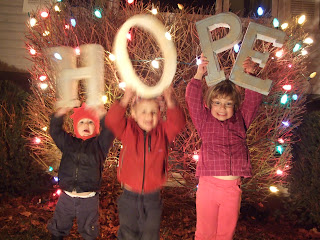
This is a shot from our Christmas card picture trial, Take One. Marginal success.  But it was fun.

Hope this finds you warm and cozy with the scent of fresh winter greens somewhere nearby (except spruce, I don't like spruce).

-Sally